

The sea is a very strange place. Three quarters of the earth’s creatures by weight live in the sea. For every tiger, four sharks, for every vole four anchovies, give or take. If you came from another planet you might be forgiven for thinking that the surface of the sea was the outer limit of this planet’s atmosphere. It’s all going on in there.
And it covers two thirds of the surface of the planet. The bit where we live is the small bit. However many miles you can walk on God’s green earth, you can swim twice as many miles over the sea.
For land-dwellers there is something fundamentally weird about the sea. It doesn’t stay still. It has no shape. There are no landmarks. And also there’s the small matter of it being unbreathable. Lie down in a field and you’ll be fine. Lie down in the road … you’ll probably be ok, people will steer round you and give you nothing worse than a telling off. Lie down in the sea for more than a few minutes and that’s it.
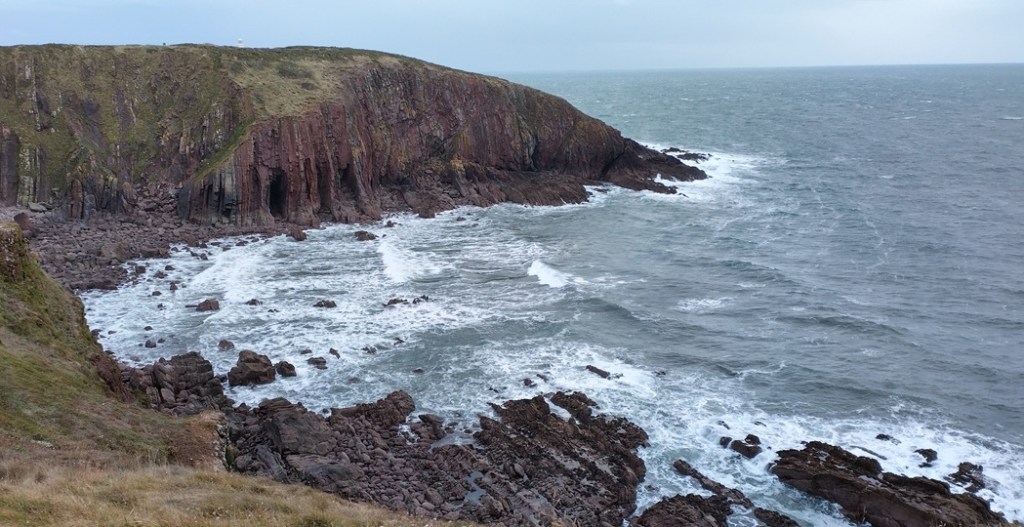
If we find something menacing in the sea – this roiling mass of inchoate unbreathable death-fluid, inhabited by bizarre creatures beyond our ken – we may be onto something. In the Bible the sea often symbolises the formless void from which God creates the orderly world of dry land, and the menacing chaos by which the creation is threatened.
But remember that the Bible was written by hill people. They knew little of navigation (when St James uses a sea-faring metaphor he betrays an ignorance of how sailing ships actually manoeuvre). And after all, God did make the oceans. The sea, with all its fathomless mystery and infinite horizons, and the stupendous power of a storm at sea, can also hint to us of God’s eternity. It can certainly remind us that we are very small, and that is no bad thing.
So why not try ten minutes of listening silence on the sea shore. Again, a little research would be good. You need somewhere that’s not too crowded. Ideally somewhere you have a beach, a cove or a cliff (or even a boat) to yourself. At least where you are out of earshot. The idea is to be able to gaze at the sea in your silence.
Unlike the public place or the place with the view, there will be less here to distract you. There may be beauty and variety in the light on the waves and the changing forms of the clouds. But not things that demand a response, an interpretation, a reaction, an assessment. What you see when you look out to sea is perhaps more alien, and certainly has less clearly stated purposes, than what you see on land. You know where you are with a tree or a shopping centre. The sea is mysterious. But not a mystery you can unpick or decipher.
So just be there. Again, make sure you are comfortable. Sitting on a flat beach your back may ache after ten minutes. Maybe a deckchair or a rock or a bench? Find a spot where you don’t see the land, or only in the corner of your eyes. Then ten minutes. Sit. Be here, now. Listen. Gaze. The sea is not going anywhere. Every part of it is part of every other part. Let it be for you an image of the reality that whatever else is here, now, God is here, now.
 Season of Silence